Costs & Budget
Budget Bathroom Renovation Ideas: Where to Save and Where Never To
By Remodler · · 13 min read
There are two kinds of budget bathroom renovation: the one where you spend less, and the one where you pay twice. This article is about staying in the first category.
The numbers here are current 2026 Sydney figures from jobs we've priced and built across the Hills District and Western Sydney — not national averages pulled from a spreadsheet. We'll walk through what a genuinely tight budget can achieve, what a mid-range budget buys, where to spend, where to save, the sequencing that keeps costs down, and how to read a quote so you're comparing apples with apples.
What "budget" actually means in a Sydney bathroom in 2026
Every year we get calls from homeowners who've seen a $6,000–$8,000 bathroom renovation figure online and want to know why our itemised quote for the same room comes in at three times that. The short answer: those figures are for a fresh-paint-and-new-tapware cosmetic refresh, not a renovation with demolition, new waterproofing and licensed plumbing and electrical work.
For a standard 6m² Sydney bathroom in 2026, a genuine full strip-out renovation — new waterproofing, new tiling, new fixtures, licensed trades, HBCF home warranty insurance where the job exceeds $20,000 — realistically starts at $18,000–$22,000 and moves up from there depending on finishes and any layout changes.
Budget doesn't mean cheap materials everywhere. It means being deliberate about which 20% of decisions drive 80% of the cost, and spending accordingly.
Cosmetic refresh vs full strip-out: which one is actually right for you
This is the first decision, and it determines almost everything else about your budget. Get it wrong and you either overspend on a room you'll gut in five years, or underspend and mask a problem that gets worse.
When a cosmetic refresh makes sense
A cosmetic refresh — new tapware, a new vanity, professional regrouting or a hard-wearing epoxy regrout, a fresh coat of bathroom-rated paint above the tiled area, new mirror and accessories — costs roughly $4,000–$9,000 and can transform how a bathroom looks and functions.
It only makes sense if the waterproofing membrane behind the tiles is still sound, there's no evidence of movement, staining on the ceiling below, or a musty smell in the wall cavity. If you can't verify that, a refresh is a gamble.
When you need a full strip-out
If the bathroom is more than 20–25 years old, has ever had a leak, has drummy or cracked tiles, or if you're changing the layout at all, a full strip-out is the only responsible option. Tiling over old waterproofing, or worse, over old tiles, just delays and compounds the eventual repair.
A full strip-out also lets you fix the things a refresh can't touch: undersized extraction, poor falls to the drain, and outdated rough-in plumbing.
Where the money actually goes
Homeowners consistently overestimate the cost of tiles and underestimate labour. On a typical $28,000 Sydney bathroom, in a home with no major surprises, the rough split is:
| Trade / item | Share of budget | Approx. $ |
|---|---|---|
| Demolition, strip-out and skip bin | 5–8% | $1,600–$2,200 |
| Plumbing rough-in and fit-off | 15–18% | $4,200–$5,000 |
| Electrical (rough-in and fit-off) | 5–7% | $1,500–$1,900 |
| Waterproofing (membrane, certification) | 4–6% | $1,200–$1,700 |
| Tiling labour | 18–22% | $5,000–$6,100 |
| Tiles and setting materials | 10–14% | $2,800–$3,900 |
| Vanity, tapware, toilet, fixtures | 15–20% | $4,200–$5,600 |
| Glass shower screen and mirrors | 5–7% | $1,400–$1,900 |
| Project management, insurance, HBCF warranty | 8–10% | $2,200–$2,800 |
Swipe the table to see all columns.
The five best places to save
Every one of these saves real money without compromising the life of the bathroom.
1. Keep the fixtures where they are
This is the biggest single lever. Leaving the toilet, shower and vanity on their existing waste points avoids slab cutting and drainage re-runs — typically $3,000 to $6,000 saved on a standard bathroom, because you're not paying a plumber to cut concrete, re-lay pipe to new falls, and patch and re-waterproof the slab.
2. Choose a mid-range large-format porcelain
A $45/m² Spanish or Italian-look porcelain in a warm neutral looks close to indistinguishable from a $120/m² tile once it's on the wall in a 6m² room. Spend the difference on the shower screen instead — glass is far more visible than the exact tile brand.
3. Standard-size vanity, upgraded top
A stock 900mm or 1200mm vanity with a quality stone or engineered top reads as custom for a fraction of the price of custom joinery. Custom only earns its cost when the space is genuinely non-standard — an awkward corner, a very narrow wall, or a specific storage need.
4. Paint the ceiling and any non-wet wall
Full floor-to-ceiling tiling on all four walls is a significant cost. Tiling to 2100mm in wet zones and painting above it with a quality washable bathroom paint saves hundreds in tile and hundreds more in labour, since tiling labour is charged per m² and painting isn't.
5. Do two bathrooms in one program
Counter-intuitive, but if both rooms need doing within a few years, combining them saves 15–20% per room in mobilisation, deliveries and trade scheduling — one skip bin booking, one set of plumber and electrician site visits, one waterproofer on site for both rooms.
The five places you must not save
These are the ones we get called back to repair — usually for more than the original saving would have been worth.
- Waterproofing. A certified membrane to AS 3740 is the entire reason the room lasts. A failed membrane means demolishing the finished bathroom to fix it — you lose the tiles, the vanity install, and the labour, all over again.
- The shower base and hob. Correctly built and tiled bases outlast acrylic inserts by decades. This is where almost every leak we investigate originates.
- Ventilation. A cheap fan ducted into the roof cavity, rather than outside, moves your moisture problem into your ceiling instead of removing it.
- The mixer cartridges. Budget tapware fails at the cartridge within a few years, and replacement means dismantling the finished wall to get at it.
- Licensed trades and insurance. Unlicensed plumbing and waterproofing voids your home insurance and can't be certified at sale — it's also illegal for notifiable work in NSW.
Materials that look expensive but aren't
Part of doing a budget bathroom well is knowing which finishes punch above their price. These are the ones we specify constantly when a client wants a high-end look on a mid-range budget.
- Large-format porcelain (600x1200mm or bigger) in a plain, unpolished finish — fewer grout lines read as more expensive than a busy pattern tile at twice the price.
- Matte black tapware — a $180–$260 mixer in matte black looks like a $500 designer piece; the finish does more visual work than the price tag.
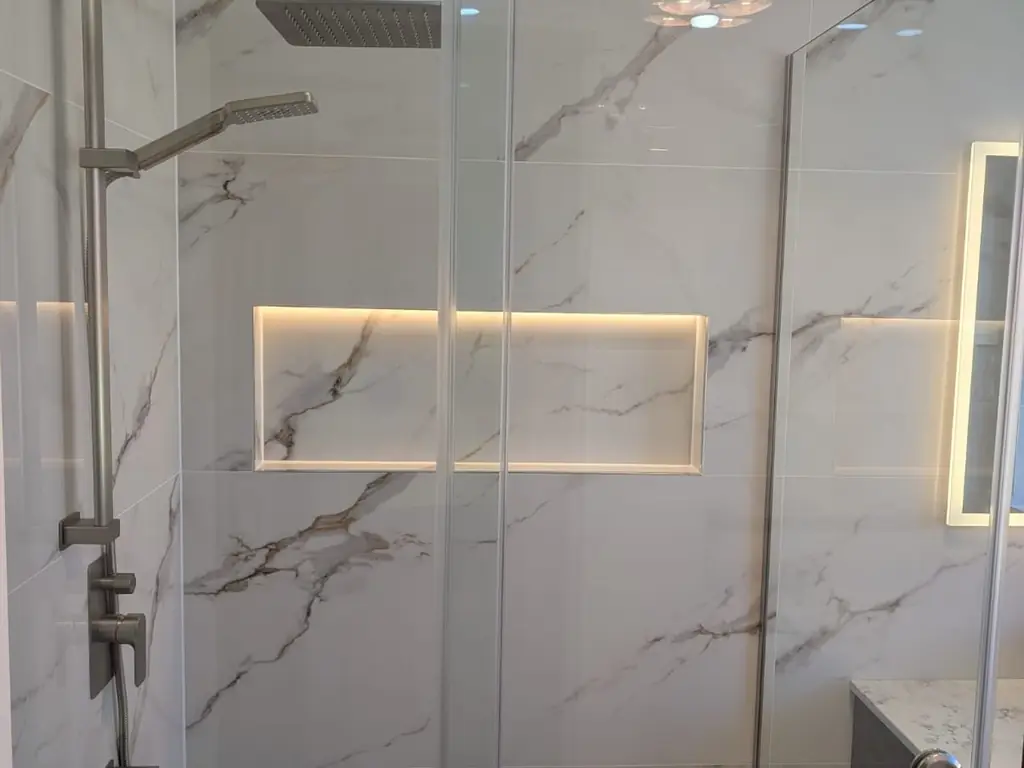
- A single feature tile band or niche in a premium tile, rather than covering the whole room in it — you get the designer moment for 5% of the tile cost.
- Engineered stone vanity tops over natural stone — visually near-identical in a photo, and far more consistent and durable for the price.
- Semi-frameless glass screens instead of fully frameless — a $150–$300 saving with almost no visual difference from two metres away.
What you can realistically get for each budget
Honest brackets, Sydney metro, based on a standard 6m² bathroom in 2026:
- Entry-level full strip-out, small bathroom
- $18k–$22kEntry-level full strip-out, small bathroom
- Typical Sydney full renovation
- $25k–$35kTypical Sydney full renovation
- Larger or reconfigured bathrooms
- $38k+Larger or reconfigured bathrooms
- Typical on-site build time
- 4–6 wksTypical on-site build time
$18,000–$22,000
A genuine full strip-out in a small bathroom with no surprises: fixtures staying in place, mid-range porcelain, stock vanity, semi-frameless screen, standard tapware, certified waterproofing and licensed trades throughout. Below $18,000 for a full strip-out in Sydney, look very closely at what's excluded from the detailed written contract.
$25,000–$35,000
The typical Sydney full renovation: complete strip-out, new waterproofing, large-format tiling floor to ceiling, quality vanity with stone top, frameless glass, good tapware, new lighting and ventilation. Minor layout changes possible without major cost blowouts.
$38,000–$60,000+
Larger rooms, relocated fixtures, custom joinery, premium tapware and stone, freestanding bath, underfloor heating, feature lighting. This is where Hills District ensuites and acreage main bathrooms usually land.
Sequencing: how the trades run through a budget renovation
Sequencing matters just as much as material choice for keeping a budget renovation on track, because every day a trade sits idle waiting for another trade is a day you're paying for.
| Stage | What happens | Typical duration |
|---|---|---|
| Strip-out & demolition | Remove tiles, fixtures, old waterproofing; skip bin on site | 1–2 days |
| Rough-in plumbing & electrical | Move or extend pipework and cabling behind the walls, before lining | 2–3 days |
| Framing & sheeting | Villaboard/wet-area sheeting, hob build, fall screeds to floor waste | 2–3 days |
| Waterproofing | Membrane applied to walls and floor, cured, then certified | 1–2 days + cure time |
| Tiling | Floor then walls, typically 15–25m² of tiling | 5–8 days |
| Fit-off | Vanity, toilet, tapware, mixer, glass screen, mirror, accessories | 2–4 days |
| Electrical fit-off & final clean | Lighting, exhaust fan, heated towel rail, final detailing | 1 day |
Swipe the table to see all columns.
Cost traps in older Western Sydney homes
Homes built before the 1990s across the Blacktown, Penrith and Hills District areas carry specific risks that don't show up until the walls are open. Budgeting for these upfront, or at least having a contingency, avoids the nastiest surprises.
- Asbestos sheeting behind tiles or as the wall lining itself — common in homes built before 1987. Testing and safe removal by a licensed contractor typically adds $800–$2,500 depending on the extent.
- Undersized or corroded waste pipes — 40mm waste where 50mm or 65mm is now required, or galvanised steel pipe that's rusted from the inside. This often only becomes visible once the old vanity or bath is removed.
- Timber floor structures that flex under the shower base — older homes on timber joists sometimes need additional bracing or a compressed sheet floor before tiling to prevent tiles cracking later.
- No existing exhaust ducting to outside air — many older bathrooms vent into the roof space or not at all, meaning a new duct run has to be added, sometimes through brick veneer.
- Non-compliant existing electrical, like a light switch inside the wet zone, that has to be relocated to meet current AS/NZS 3000 wiring rules before a certifier will sign off.
PC sums, provisional sums and variations — what they mean for your budget
These three terms cause more budget disputes than anything else in a bathroom renovation, so it's worth understanding them before you sign a detailed written contract.
PC sums (prime cost)
A PC sum is an allowance for an item you haven't chosen yet — commonly tiles, tapware or the vanity. If your itemised quote says "tiles: PC $45/m²" and you choose a $65/m² tile, you pay the $20/m² difference plus the tiler's margin on it. Always ask what the PC rate actually buys, because a $25/m² PC allowance won't stretch to a decent porcelain.
Provisional sums
A provisional sum covers work that can't be accurately priced until it's uncovered — like plumbing rectification behind a wall, or asbestos removal. It's an estimate, not a firm number, and the final cost is charged based on actual work done.
Variations
A variation is any change to the agreed scope after the contract is signed — moving a tap, upgrading a tile, adding a niche. Legitimate variations should always come to you in writing with a price before the work happens. If a builder does variation work first and tells you the cost afterwards, that's a red flag.
Tiling labour rates and why they vary
Tiling labour is usually the single largest line item after fixtures, and the rate per m² varies for real reasons, not just margin.
| Tile type / layout | Typical labour rate | Why |
|---|---|---|
| Standard format wall tile (300x600mm) | $65–$85/m² | Standard cutting, straightforward layout |
| Large-format porcelain (600x1200mm+) | $85–$120/m² | Needs a second person to lay, tighter tolerances, more waste on cuts |
| Herringbone or pattern layout | $110–$160/m² | Far higher cutting time and wastage, more setting-out |
| Mosaic (shower floor / niche) | $90–$140/m² | Slow to lay, more grout lines, more time per m² |
Swipe the table to see all columns.
How to read a cheap quote
A quote that's 30% below the others isn't usually a better deal — it's a different scope. Ask these questions before you compare prices on an itemised quote:
- Is waterproofing included, by a licensed waterproofer, with a certificate?
- Is demolition and waste removal included, or is the skip bin your cost on top?
- Is asbestos testing included, and what happens to the price if it's found?
- Are tiles a PC (prime cost) allowance, and at what rate per m²?
- Which tapware brand and model, specifically — not just "quality tapware"?
- Is the shower base tiled or a pre-formed acrylic insert?
- Who provides the warranty, for how long, and does it cover waterproofing specifically?
- Is HBCF home warranty insurance included for work over $20,000, as NSW law requires?
- Are electrical and plumbing rough-in and fit-off itemised separately, or bundled into one vague line?
- What's explicitly excluded from the contract — this list is often more revealing than what's included.
Financing and staging
If the budget genuinely isn't there yet, staging is smarter than cutting the build quality. Renovate one bathroom properly this year and the second next year, rather than doing both to a standard you'll be redoing in eight years.
What we don't recommend is "doing the tiling later" or splitting a single bathroom's work across two budgets. Every element in a bathroom is sequenced and interdependent — a half-finished wet area isn't a saving, it's an unusable room, and remobilising trades for stage two of the same bathroom usually costs more than finishing it in one program.