
Planning & Process
Bathroom Renovations in the Hills District: Castle Hill, Baulkham Hills and Kellyville
By Remodler · · 12 min read
If you live in the Hills, you have probably had the same conversation twice: the bathroom is tired, you have looked at three quotes that all say something different, and nobody has explained why. The reason is almost never the tiles. It is what is behind them, and that changes street by street across the Hills District.
We renovate bathrooms across Castle Hill, Baulkham Hills, Kellyville, North Kellyville, Cherrybrook, Glenhaven, Winston Hills and Pennant Hills. Same crew, same waterproofer, same tiler. What changes is the house — the era it was built, whether the floor is slab or timber, whether the block slopes, and how much the drainage can move.
This guide walks through the three suburbs we are called into most, what we consistently find when the wall tiles come off, what it costs, and what the timeline realistically looks like. If your suburb is not listed, skip to the cost and timeline sections — they hold across the district.
Why the Hills needs its own guide
Generic renovation advice assumes a single-storey slab home with modern plumbing. Large parts of the Hills are not that. Between the 1970s subdivisions and the late-1990s estates there are three distinct construction eras within a ten-minute drive of each other, and each one fails in a predictable way. For a broader overview of what we do across the city, see Bathroom Renovations Sydney.
That predictability is the useful part. Once we know when your house was built, we can tell you at the measure — before you sign anything — whether the shower waste can move, whether the walls need re-sheeting, and whether asbestos testing belongs in the quote.
- Hills District bathrooms completed
- 120+Hills District bathrooms completed
- Typical time on site, one room
- 3–4 wksTypical time on site, one room
- Google rating across Sydney jobs
- 5.0Google rating across Sydney jobs
Castle Hill: 1990s double-storey homes with two wet areas
The most common Castle Hill bathroom we are called into is the original 1990s fit-out — cream tiles to waist height, a framed shower screen with a rusted track, and a vanity swollen at the base. Nothing is broken. The room is simply finished with what it had.
Castle Hill houses tend to be generous: double-brick or brick veneer on 600–800sqm blocks, main bathroom and ensuite upstairs, powder room down. Two wet areas over a timber floor means substrate and waterproofing detail matter far more than the tile you choose.
What we plan for
Upstairs floors get checked for joist spacing and deflection before sheeting goes down. If the floor moves, the tiles crack and the membrane eventually follows — no amount of good tiling saves a soft substrate.
- Stiffened substrate and a properly stepped shower floor rather than a hob-and-hope detail
- Licensed waterproofing to AS 3740 with photos at each coat and a compliance certificate at handover
- Main and ensuite priced as separate line items so you can stage them or do both at once
Where Castle Hill money is best spent
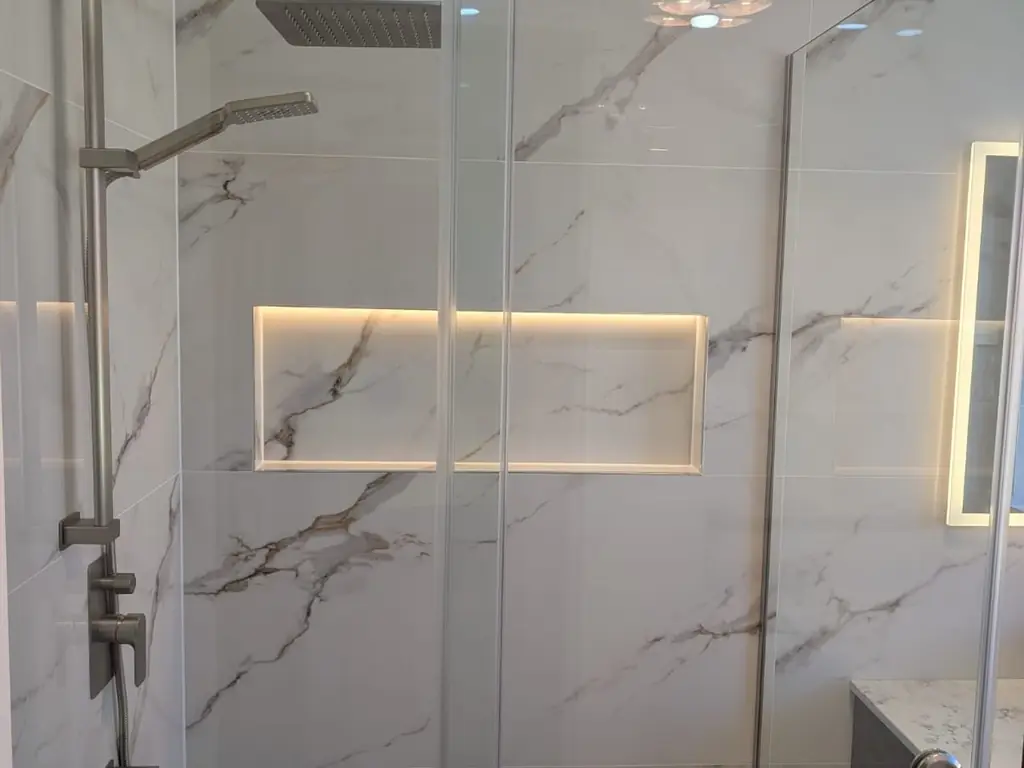
Buyers here notice bathrooms, so finishes that read current for a decade beat finishes that read current for a season. Large-format tiles, a wall-hung vanity, semi-frameless glass and a single good tapware suite outperform a feature wall every time.
Baulkham Hills: 1970s–80s brick homes on sloping blocks
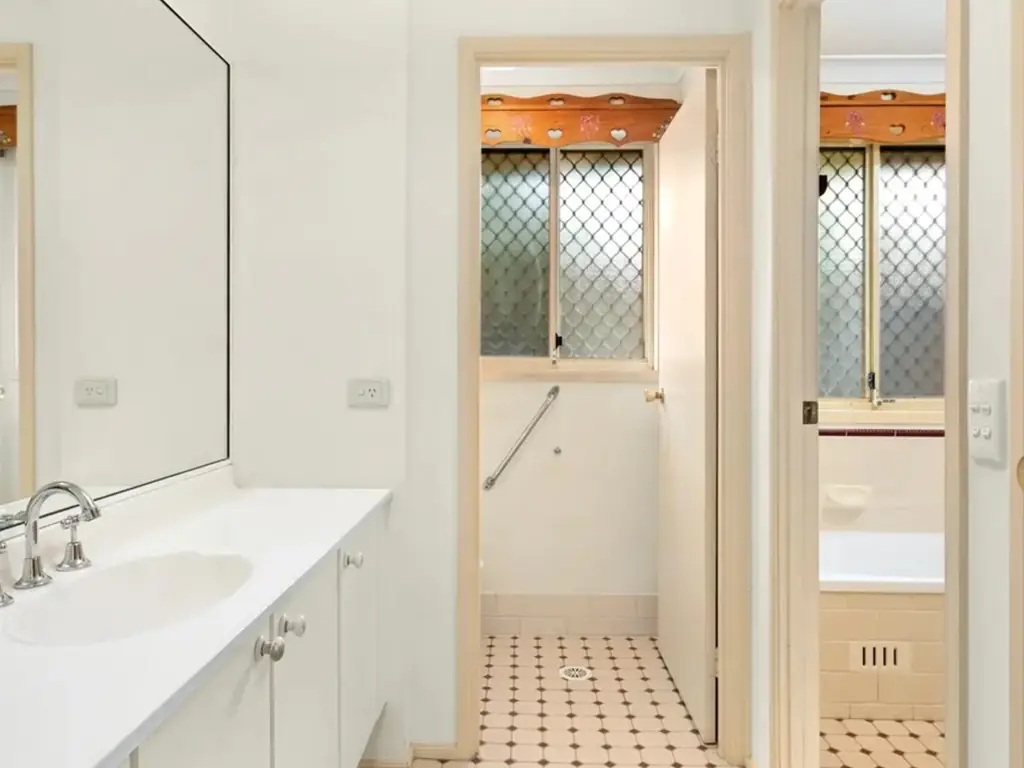
Baulkham Hills is full of 1970s and 80s brick homes where the bathroom has been patched twice and never actually rebuilt. Take the wall tiles off and you generally find original render, a shower base with no fall, and waterproofing that was a coat of paint.
The blocks here slope, so plenty of homes have a bathroom sitting over a suspended floor or a garage. That changes how we set drainage and how far the shower waste can move. We work that out at the measure, not halfway through demolition, and it goes in the written quote.
- Rendered brick from the 70s rarely comes off clean — allow for re-sheeting or re-rendering to a true face so large-format tiles sit flat instead of lipping
- Separate toilet and bathroom is the norm; removing the dividing wall is the single highest-impact change available
- Asbestos sheeting is common in eaves, wet-area linings and old vanity backing — testing first is cheaper than stopping work later
Kellyville and North Kellyville: 1998–2010 estate builds
Kellyville bathrooms are rarely structurally troubled. They are slab-on-ground, PVC-drained and dry. The problem is that they were built to a display-home budget: builder-grade vanities, small format tiles, a corner spa nobody has used since 2009, and a shower that is 100mm too small to be comfortable.
That makes Kellyville the most predictable suburb we work in. Very little demolition risk, very few surprises, and the money goes into fixtures and finishes rather than repairs.
| Existing | What we do | Why it matters |
|---|---|---|
| Corner spa bath | Freestanding or built-in bath, or delete for a larger shower | Recovers 400–600mm of usable floor |
| 900mm shower | Widen to 1100–1200mm within the footprint | Biggest comfort gain per dollar |
| Builder-grade vanity | Wall-hung vanity with stone top | Reads current for a decade, easier to clean |
| Small-format wall tiles | Large-format tiles, fewer grout lines | Looks larger, far less maintenance |
Swipe the table to see all columns.
What it costs across the Hills right now
These are the ranges we are quoting in 2026 for a full strip-out and rebuild, including waterproofing, tiling, plumbing, electrical, fixtures and rubbish removal. They are ranges, not prices — your quote should be itemised line by line so you can compare it against anyone else's.
- Layout changes that move the shower waste or toilet are the biggest single cost swing
- Stone benchtops, tapware suites and frameless glass move the number more than tile choice does
- Asbestos remediation, when needed, is usually a four-figure line rather than five
| Suburb | Main bathroom | Ensuite | Main + ensuite together |
|---|---|---|---|
| Castle Hill | $24,000 – $38,000 | $18,000 – $26,000 | $38,000 – $58,000 |
| Baulkham Hills | $22,000 – $34,000 | $17,000 – $25,000 | $35,000 – $54,000 |
| Kellyville | $23,000 – $35,000 | $17,000 – $25,000 | $36,000 – $55,000 |
Swipe the table to see all columns.
The timeline, honestly
Three to four weeks on site is normal for one bathroom in the Hills. The part people underestimate is the front end: selections and ordering. Tapware and tiles with long lead times are the most common reason a job that could have run in three weeks takes six.
- Week 0 — measure, itemised quote, selections locked and materials ordered
- Week 1 — strip-out, any remediation, rough-in plumbing and electrical, substrate prep
- Week 2 — waterproofing with photo records and cure time, then screed and tiling starts
- Week 3 — tiling completed, grouting, fixtures and glass
- Week 4 — tapware, silicone, final electrical, clean and handover with certificates